If you want to know how people really feel about you, watch how they treat your children. Their tone. Their effort. Their interest. People who respect you will show that same care to your children. People who pretend to like you, won't..
Original writing by Zenda-Lee Williams
My Writing
I began sharing my writing in May 2025. I was scared to let people see it. I shared it anyway.
Personal reflections on survival, accountability and the things I notice.

The beginning
Why I write
In May 2025, I started writing because I needed somewhere to put the things I could no longer carry silently.
I did not start because I thought I had something important to teach people. I was trying to understand my own life. I had spent so long questioning what I felt, what I remembered, what I saw and whether I was somehow getting it all wrong. Writing gave me somewhere to tell the truth without being interrupted, corrected, dismissed or made to doubt my own understanding of what was happening to me.
Letting other people read those words terrified me. They were not carefully constructed stories written with the benefit of distance. Some came from pain. Some from anger. Some from fear and confusion. Some were written while I was still trying to understand things I can see very differently now. Publishing them meant allowing strangers into parts of my life I had barely learnt to look at myself.
Then survivors started recognising themselves in my words. They would say, “I thought it was just me,” or, “I have never known how to explain this.” That changed something for me. I realised that the words I had written to make sense of my own experience could give somebody else language for theirs.
So I kept writing.
I write about what abuse feels like from the inside. I write about what it does to your thinking, your sense of reality, your relationships, your body and the way you see yourself. I write about behaviour we are taught to excuse and things people still minimise because acknowledging them properly makes people uncomfortable. I write about what I understood then and what I understand now.
Writing helped me reclaim something I had lost for a long time: trust in my own voice.
It did not erase what happened. It did not turn pain into something beautiful. There are still things I am angry about. Things I question. Things I am still making sense of. Healing does not require me to rewrite any of that into a prettier story.
Today, I write because silence protects too much of what hurts people.
If something I write gives one survivor the words to describe what they could never explain, helps someone recognise behaviour they have been taught to normalise, or makes another human being feel less alone in an experience that has isolated them, then there is a reason for me to keep putting these words on the page.
This is where my writing began. Not because I had found all the answers. Because I finally started trusting myself enough to ask the questions.
The work and the nonprofit
One voice. Two connected homes.
This archive is the original work of Zenda-Lee Williams. It forms part of her survivor education and awareness work connected to Rise Against Domestic Violence SA, the South African nonprofit she founded and directs.
The writing lives here on Zenda-Lee’s personal website. Her RISE profile connects the writing, survivor voice and nonprofit work in one place.
01 / The words as they came
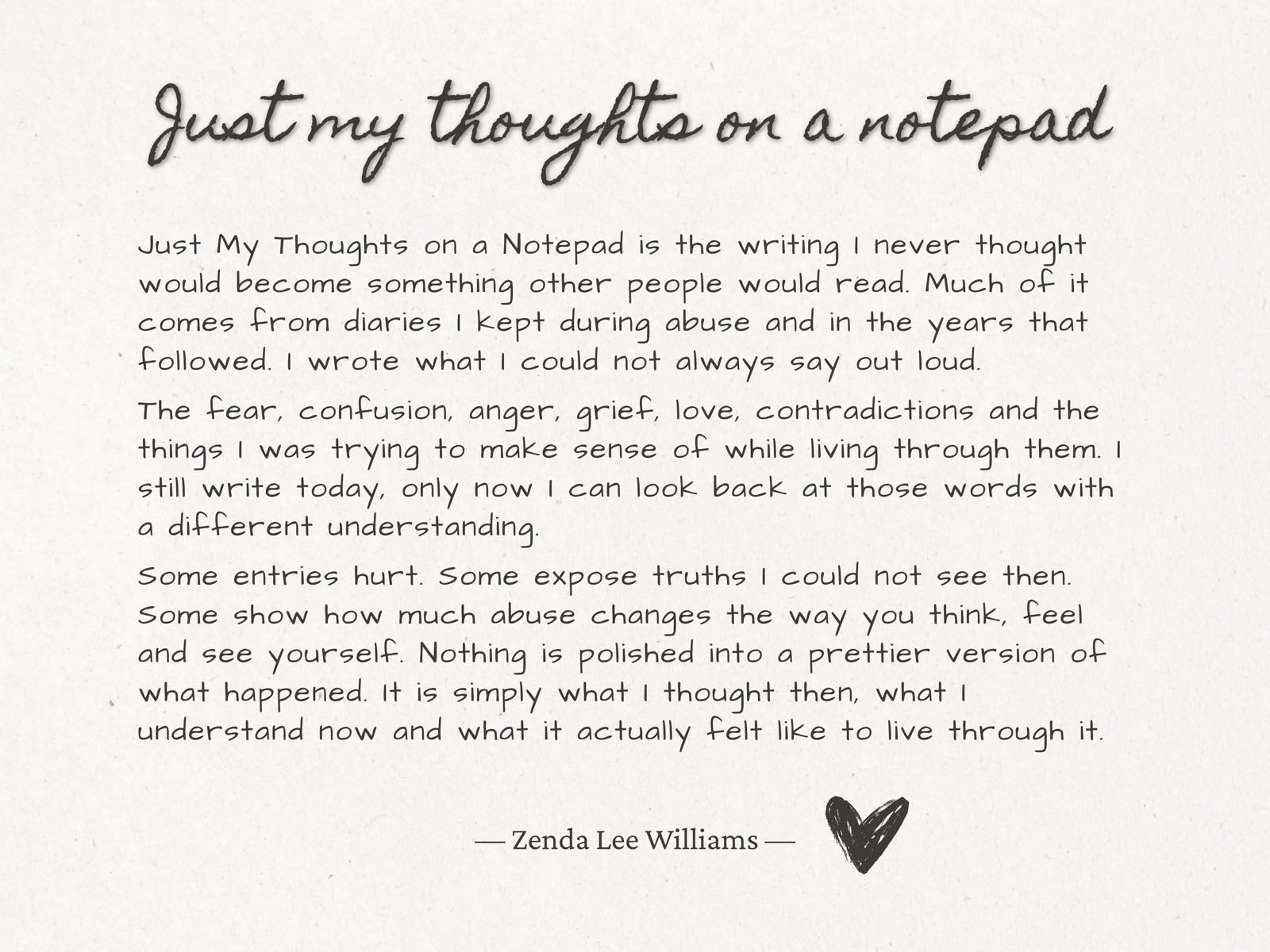
Just my thoughts on a Notepad
This is my life in words. Real experiences, not theories. Some of it heals, some of it hurts, and all of it is honest. These are the thoughts I write down when I cannot pretend I did not notice something.

VIEW 6 GRAPHICSCLOSE GALLERY
Three pieces that travelled widely
Featured writing
The most dangerous people I've ever met genuinely believe they're good. They rewrite every story, dodge every consequence, and carry zero accountability.
In their minds, they've never hurt anyone, but somehow, everyone else is always to blame.
That kind of delusion isn't just toxic, it's terrifying.
I don't sugarcoat what I've been through because it nearly destroyed me. I'd rather be blunt about my past than pretend it didn't shape who I am. Hiding it doesn't heal it. Owning it and learning from it is the only reason i am still standing.
Original graphics from the series
6 original graphics
Each design is shown in its original form. The complete writing is also provided as searchable text.
01
There were times I wished he would just hit me. So I had something I could photograph, report, point to. Something. Anything. I needed evidence so badly. That thought is terrifying. That I was taken to such a low point. It made me a person drowning in invisible harm, begging for proof the world would accept. The wish was never for pain. It was for witnesses. Mental abuse is real.
02
Narcissistic abuse is the gradual destruction of your reality, your identity, and your sanity, done so subtly that you often do not realise you are disappearing until almost nothing of you is left. It's having your entire life slowly manipulated, dismantled, and played with by someone who claims to love you. Someone who learned your heart, studied your pain, then used both against you while smiling in your face. That is what makes it so dangerous. Unless you have survived that kind of psychological warfare, you do not truly understand what it does to a person.
03
Surviving wasn't brave, it was terrifying. It felt like clawing my way out of hell while broken, shaking, and completely alone. People say "just leave" like it's easy, but they weren't there when I couldn't eat, couldn't sleep, couldn't step outside without scanning every corner. They didn't see the fear that lived in my bones or how even a knock on the door made me freeze. Nobody helped. Nobody cared. I wasn't healing, I was hiding, just trying to stay alive in a world that kept blaming me for not escaping faster.
04
The lost years...
I lost track of whole years. People ask what I did in that time and I have no answer, because survival compresses everything into one long repeated day. Wake, manage, brace, recover, repeat. Whole seasons passed without me in them. When I finally looked up, my friends had houses and careers and I had a nervous system and a suitcase. Time does strange things inside those walls. It moves, but only for the people outside them.
05
I knew something was wrong long before I admitted someone was hurting me. I just didn't know that constantly rehearsing conversations in the shower wasn't normal. I thought everyone practised explaining themselves before they spoke. Turns out, that is what happens when getting one sentence wrong has consequences.
06
Many survivors did speak. They were ignored, doubted, corrected, blamed, or told to keep the peace. Then later people ask why they never said anything. They did. The room just protected the wrong person.
02 / Awareness without apology
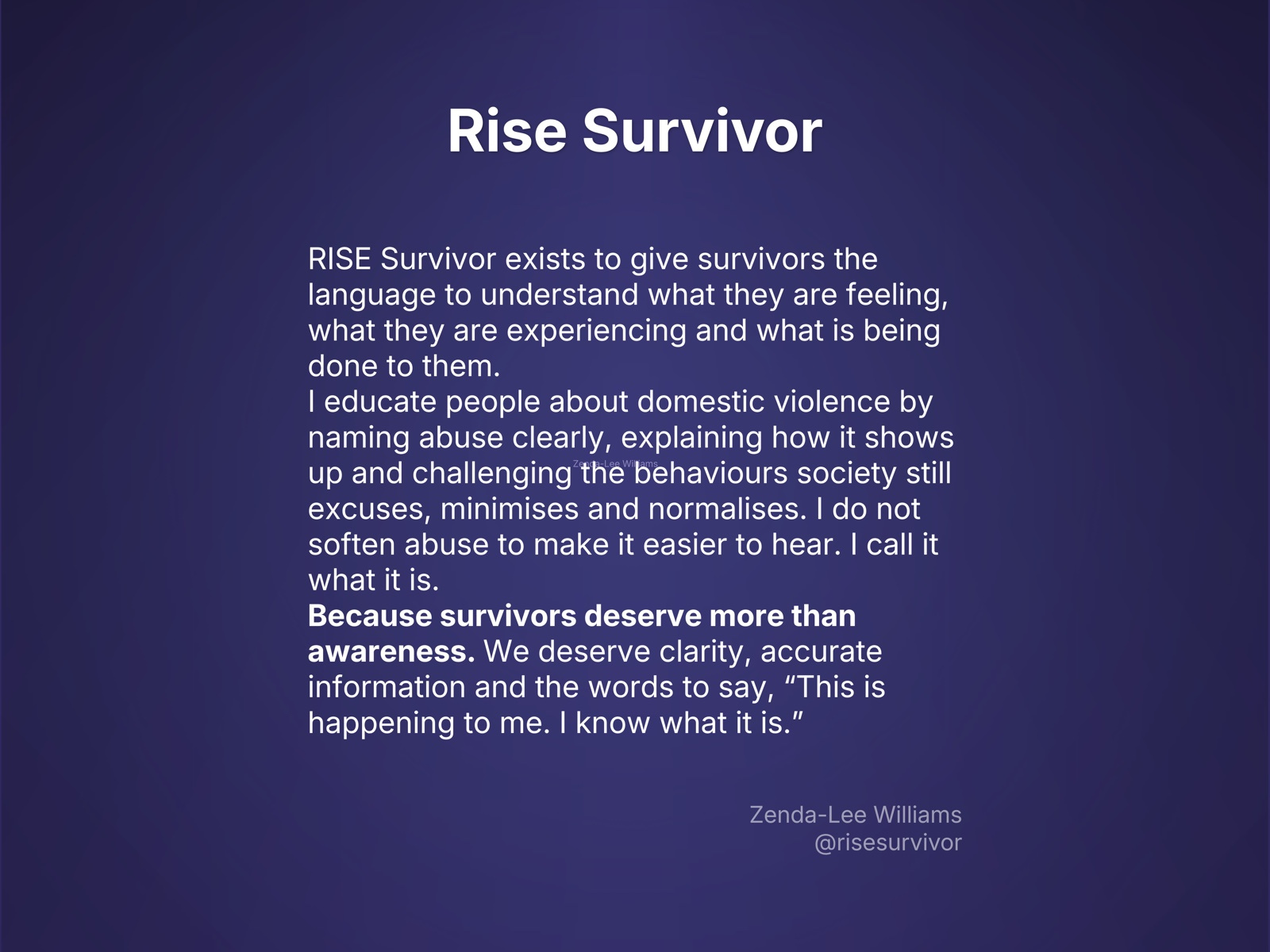
Rise Survivor
I use Rise Survivor to call out abuse plainly. I write about control, manipulation, denial and the excuses that protect people who cause harm. This series is confrontational and unapologetic. I want it to raise awareness, even when the truth makes people uncomfortable.

VIEW 10 GRAPHICSCLOSE GALLERY
Survivor awareness writing
10 original graphics
Each design is shown in its original form. The complete writing is also provided as searchable text.
01
The reaction is always easier to judge than the harm that caused it. People see the survivor crying, shouting, panicking, explaining too much, posting too much, pulling away, breaking down, and they call that the problem. They did not see the months or years of being dismissed, threatened, lied to, controlled, and cornered. Stop judging the fire when you ignored the person who kept striking matches.
02
I still hear my abuser's commentary during ordinary moments. Buying clothes, their opinion loads. Making a decision, their objection plays. Laughing too loudly, their face appears. The relationship ended, but the surveillance continued, installed and running locally in your own head. Eviction is slow work. It starts with noticing whose voice just spoke.
03
If they make you explain basic respect until you sound unstable, if they deny what happened every time, if they twist the order of events to benefit them, if they question your memory or make you question your own, and then act calm while you are losing your mind trying to prove reality, you are being mentally and emotionally abused. Abuse is not only what they do to you physically. You are a victim of domestic violence.
04
Someone asks what you enjoy and you go blank. Years of managing another person's moods deletes your own preferences. You did not lose yourself. You archived yourself to survive. The files are still there. Start stupidly small. Pick the meal you actually want. Choose the music in the car. Identity does not return in a breakthrough. It returns in 100 small choices nobody else gets a vote on.
05
If a partner has ever put their hands around your throat, even once, even lightly, even as a joke that was not a joke, you need to know something. Non fatal strangulation is one of the strongest signs that a person may one day kill their partner. It is not a fight that went too far. It is a preview. This is the warning the world keeps missing, and survivors are the ones who pay for the silence.
06
They took an innocence from me I will never get back. The way I trusted. The way I loved without fear. The way I believed people meant what they said. That version of me is gone. But what grew in her place is unshakeable. I am sharper now. I see patterns faster. I carry a wisdom that protects me. I do not call that loss anymore. I call it survival.
07
Some children bond with the dangerous parent. Nobody wants to say it. The charm is aimed at them too, while the safer parent is exhausted, hyper-alert, and left looking angry, strict, or unstable. If your child adores the person who terrorised you, it can feel like betrayal. It is not. It is the same strategy aimed at a smaller target. Stay steady. Children grow into pattern recognition.
08
They file complaints against you first. With the police. The school. Social workers. They get their version on record before you have even found the words for yours. Then, when you finally speak, everything you say is treated as retaliation. People who manipulate others know how to manipulate systems too. They arrive early, calm, convincing, and prepared. If they reported you before you reported them, understand this. They were building a case while you were still trying to survive.
09
People want abuse to be visible enough to condemn, but vague enough to ignore. They want bruises without names, trauma without timelines, pain without paperwork, and survival without accusation. The moment a survivor becomes specific, the room changes. Sympathy is easy when nobody has to answer for what they allowed.
10
The abusive co parent doesn't want the kids. They want control over you. Your emotions. Your mind. Your time. Your choices. Even the little time you have left to enjoy with your children. The children are simply another way to punish you.

03 / Pattern recognition
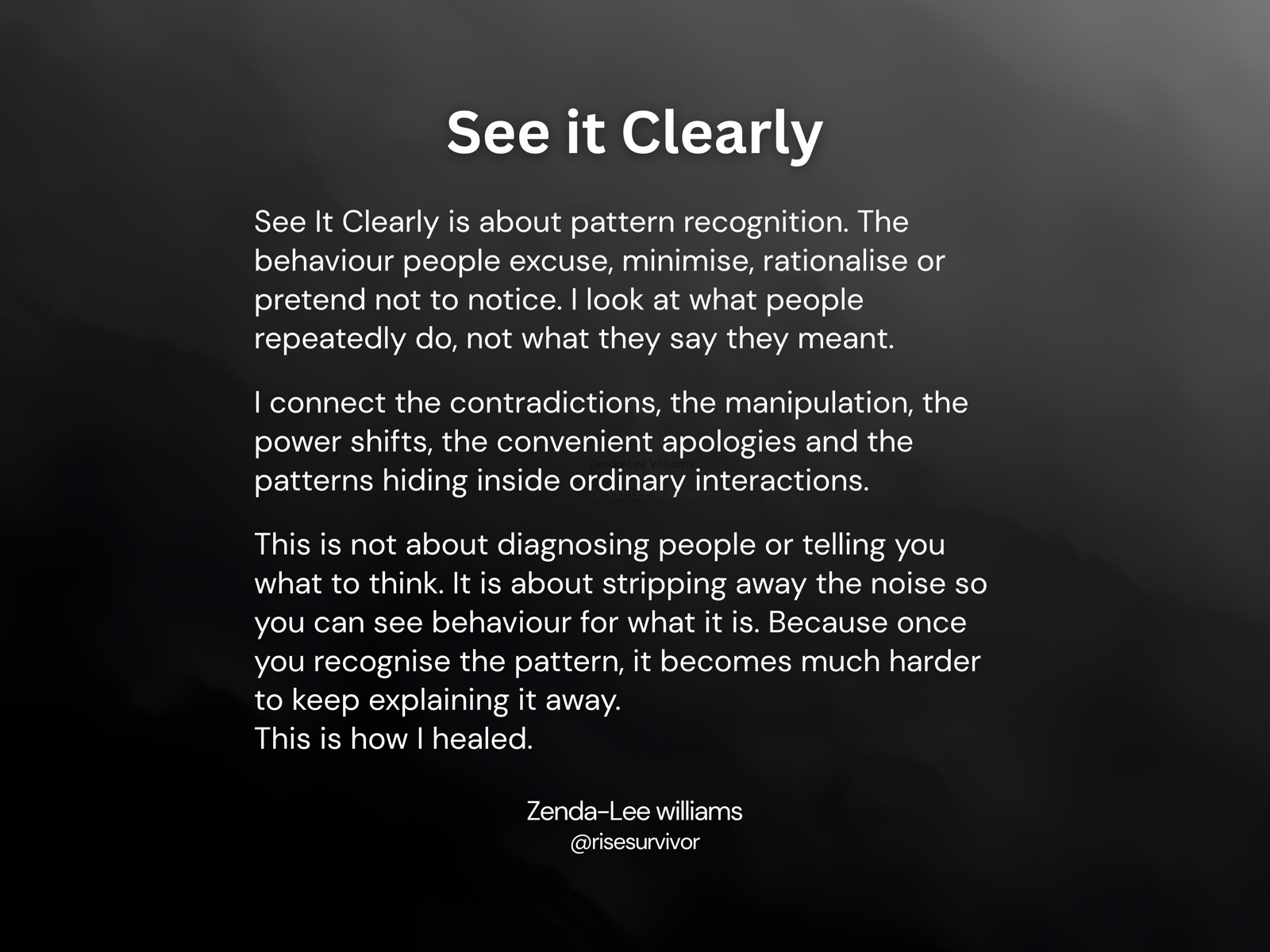
See It Clearly
Here I look closely at the patterns that can leave someone doubting what they saw. A change in tone. Kindness that appears only when someone is watching. An apology that somehow leaves you responsible. I put the details beside each other and ask what the whole picture is showing.
VIEW 10 GRAPHICSCLOSE GALLERY
Patterns named plainly
10 original graphics
Each design is shown in its original form. The complete writing is also provided as searchable text.
01
I do not need perfect people. I need honest ones. People who own what they do, say what they mean, repair what they damage, and do not turn accountability into a courtroom. I have lived through enough confusion to know the difference between a mistake and a pattern. One can be repaired. The other keeps taking.
02
If someone drives recklessly to scare you, control you, or watch you panic, that is not funny, spontaneous, or "just how they are." That fear in your chest was real. You were trapped. They knew it. The person who hurt you may deny it, minimise it, or blame you after, but fear was always part of the point.
03
When you're the scapegoat in a narcissistic family, you're fair game to everyone. They'll mock you, blame you, and break you, while the rest stand by or join in. You may only see it for what it is once you're an adult. When you do, please don't go back. Not even for closure.
04
The first night in my own place I slept with the light on and called it freedom anyway. The fridge hummed. Nobody's mood lived in the walls. I kept waiting for the catch, for footsteps, for the price of the quiet to be announced. It never was. Peace was the first thing in years that did not invoice me.
05
There was a night I hit back. One time. And for years they held it over me as proof that I was violent too, that we were as bad as each other. We were not. Defending yourself in the middle of an attack is not abuse. I carried that guilt far longer than I ever carried the bruises. If you fought back once and it still haunts you, hear me clearly. That was survival, not your character.
06
Abuse changes how you love. It teaches you to keep parts of yourself hidden, to give carefully, to watch for the slightest shift in someone's mood. You end up measuring safety by how small you can make yourself. It's a quiet, lonely way to exist, and clawing your way out of that mindset is its own kind of hell.
07
I realised I had recovered the day I spilled a glass of water and didn't panic. Nobody shouted. Nobody sighed. Nobody made me feel stupid for being human. I just cleaned it up and carried on. That was the first time I understood how much fear had been living inside ordinary moments.
08
Abusers don't confess anything, ever. They will rewrite the narrative to protect their image and you will almost always be the villain in a deeply hurtful lie.
09
When toxic people don't like someone, they don't just leave it there. They stir the pot. They twist things, talk behind your back, and try to get others to turn on you too. They can't stand on their own, so they pull people in to make it look like they're right. It's not about truth. It's about control. And if you've ever been the one they came for, you know how fast the lies spread.
10
Emotionally immature people don't think about how their behaviour affects anyone else. They go quiet when it's time to talk. They flip it on you when you're hurt. They make you feel like your needs are too much just because they don't know how to meet them. Being with someone like that keeps you anxious, second-guessing yourself, and constantly fixing things you didn't break. You start thinking it's you. It's not. You were just carrying the weight of someone who never learned how to carry themselves.
04 / From my heart
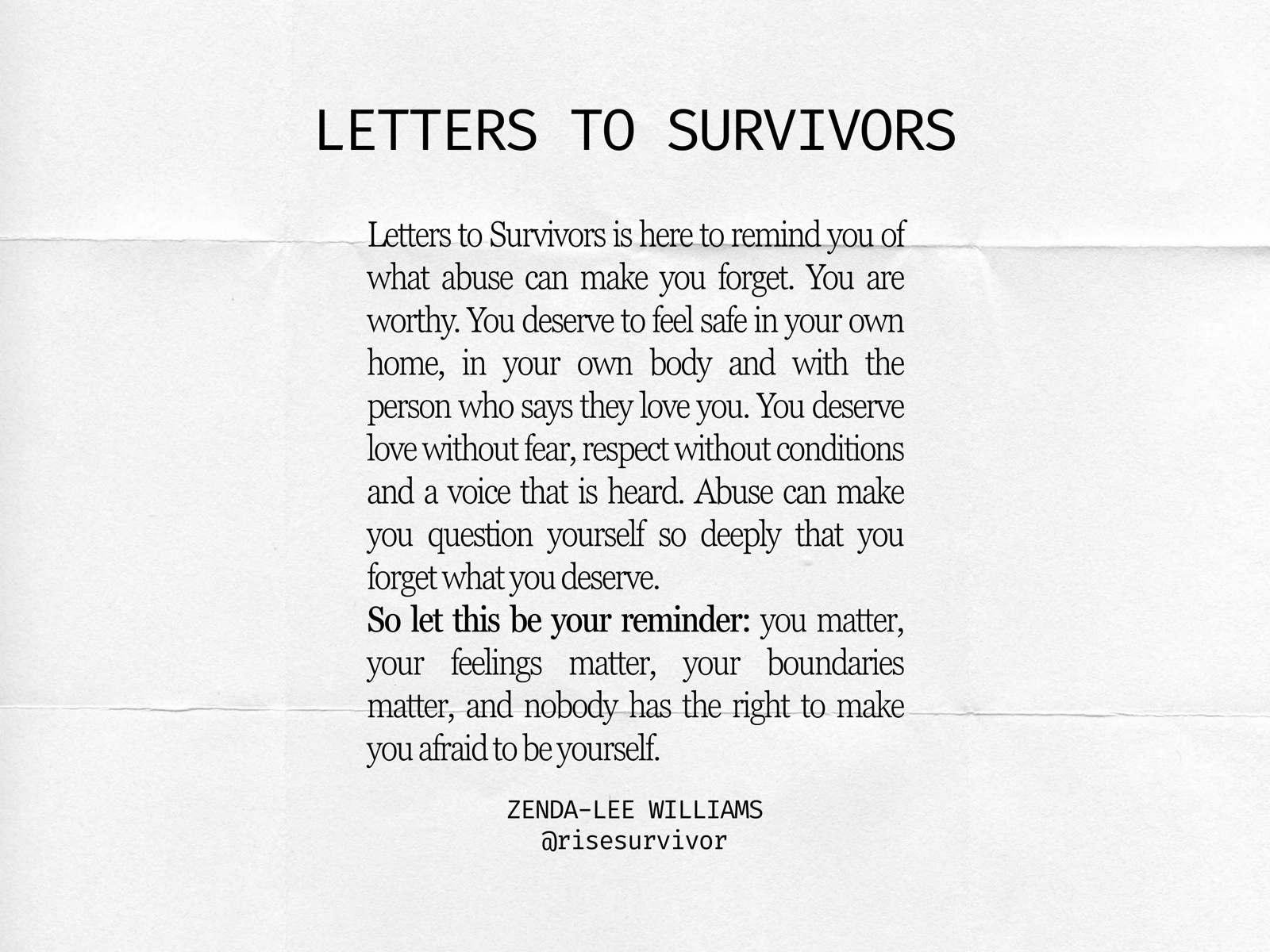
Letters to Survivors
These letters come straight from my heart to people who are hurting. I am not writing from a place where nothing hurts anymore. Sometimes I am hurting too. This is where I speak personally, without a script, a polished lesson or a deadline for anyone’s healing.

VIEW 13 GRAPHICSCLOSE GALLERY
Personal writing for survivors
13 original graphics
Each design is shown in its original form. The complete writing is also provided as searchable text.
01
After you left, the abuser became the victim of your leaving. Abandoned. Blindsided. Destroyed by your cruelty. Years of harm vanished from the story, and the ending became the real crime. Watch how many people accepted that narrative. The last chapter got submitted as the whole book, and you became the villain in a story you barely survived.
02
People on social media keep watering down serious crimes with code words like "grape" for rape, "smexual assault" instead of sexual assault, "unalive" for murder, "n4rc" for narcissist abuse, "red rum" for homecide/murder, or even "dom v" for domestic violence. It might seem harmless, but I think it does some damage. It softens the reality of brutal things that ruin lives. If you're going to speak on it, call it what it is. If that makes people uncomfortable, good, it should. Why are we conforming to platforms regarding real life traumatic situations?
03
You still lie to doctors out of habit. Fell down the stairs. Walked into a door. Stress, probably. The medical file from those years reads like fiction because you wrote it that way, under supervision, in waiting rooms with them parked outside. Tell the truth to one doctor now. The file can start telling it too.
04
Some of the worst of it happened at 120 on the highway. Screaming at the wheel, speeding up when you begged them to stop, your hand quietly finding the door handle you knew you could never use. A moving car is a room with no exits. They knew that, which is why the worst conversations were saved for it. If you still grip the seat when someone else drives, your body remembers the room.
05
I celebrate an anniversary nobody knows about. Every year, on a certain date, I buy myself flowers and cook something good, and if anyone asks I say no reason. It is the day I left. My private new year, the birthday of this second life, unmarked on any calendar but the one in my chest. Some survivors mark it with cake, some with silence, some cannot mark it at all. However you hold yours, hold it. You did the hardest thing a person can do. Somebody should raise a glass. Let it be you.
06
Yes, they had a hard childhood. So did I. So did millions of people who never once used it as a licence. Their history explains where they learnt it. It does not excuse the choice to keep doing it, decade after decade, to people who loved them, while refusing every opportunity to learn otherwise. Compassion for their past and safety for your present are not enemies.
07
Do not go to couples counselling if you're in a domestic violence relationship. It's not just unhelpful, it's dangerous. There's already a power imbalance, and sitting across from your abusermay gives them more tools to twist the narrative. As the survivor, your healing has to happen in a safe space, far away from the person who harmed you in the first place.
08
Abuser train you in increments. Year 1 tolerates what year 3 accepts what year 5 cannot even see anymore. Nobody signs up for the final version. You agreed to a hundred small adjustments, each one survivable, each one lowering the floor. Look back at your first boundary. Notice where the floor is now.
09
You were called crazy after years of being pushed, dismissed, provoked, blamed, and emotionally worn down. Nobody questioned what happened before you reacted. They judged the moment you finally broke. Exhaustion changes how you respond. Constant hurt changes your patience. Repeated disrespect changes your tone. Your reaction became the evidence against you. Their behaviour disappeared from the story.
10
The hardest part was not discovering what they did. It was discovering that the person I defended, protected and believed in was the same person I needed protection from.
11
I'm not afraid of strangers anymore. I'm afraid of the people closest to me. The ones who know exactly where it hurts and press harder. The ones who smile while they do it. The ones the world still believes are good people.
12
Covert abuse rewired me. It made me second guess the tone of a voice, the pause before a sentence, and the look in someone's eyes. It made me feel crazy for noticing shifts in someone's behaviour, guilty for reacting, and ashamed for expecting something different. I still question myself and wonder whether I will ever be able to trust myself again.
13
A kind liar is still a liar. A crying manipulator is still manipulating. A polite person who denies your reality is still dangerous to your peace. Survivors are judged by their reaction while the person who hurt them is protected by their presentation. That is how harm survives in public.
Author
A Domestic Violence Survivor's Guide Through Complex PTSD
I am the author of A Domestic Violence Survivor's Guide Through Complex PTSD. I published it independently online, and it has been downloaded more than 140,000 times. I wrote it from lived experience, years of survivor advocacy, trauma informed practice and the thousands of conversations behind my work.
I did not write it to explain survivors to outsiders. I wrote it for the person living inside the aftermath and trying to understand what happened to their mind, body, relationships and sense of self.
An ongoing collection
This space will grow.
I will keep adding to these series as I write. Each has a different voice and purpose. They are all mine.
Some of my writing is also on Substack. You can read there, or return here as this collection grows.